1
Blot
Press the fold. Do not rub the base outward.
Nose separation is not a full-face failure. It is usually a small-zone layer break that needs a smaller correction.
“Repair only the broken seam, then stop.”
The quick answer is the short version. The complete route is still simple: blot the fold, flatten the seam, and replace only the coverage that is missing.
Use what you own first. Leave every area that still looks good untouched.
Press the fold. Do not rub the base outward.
Lift the loose edge until the seam looks thin again.
Replace only the coverage that is visibly missing.
VELIO carries the nose-zone concern into the mirror read and returns one practical color-and-wear route. The goal is a smaller correction, not another full layer.
Free first read · Non-diagnostic · Use what you own first
The nose sidewall looks broken while the cheeks still look normal.
Foundation gathers near the nostril fold or smile-line edge.
Adding more product makes the same spot look thicker.
Powder helps for a moment but the seam comes back.
The nose combines warmth, movement, product overlap, and a small curved surface. When foundation breaks there, rebuilding the entire face usually creates more visible weight than the original problem.
Lift the loose layer, flatten the seam, and replace only the coverage that is visibly missing.
Look for: A narrow broken line appears beside the nostril while nearby coverage still looks intact.
What it means: The repair should be smaller than a fingertip, not a new layer across the center face.
Look for: Foundation gathers around the fold or looks thicker after every touch-up.
What it means: The surface is carrying too much product for the amount of movement there.
Look for: The area looks repaired for a few minutes, then separates again.
What it means: The prep-base-powder stack is probably too dense for that zone.
This is a cosmetic correction route, not a diagnosis. Stop after the smallest step that restores clarity.
Press the nose zone with tissue or blotting paper to remove oil and loose product without spreading it outward.
Use a clean detail sponge or cotton swab to lift the broken edge until the surface looks thin again.
Tap a very small amount of precision concealer or base only onto the visible gap. Set the edge, not the whole nose.
Press the separated area once with a clean sponge. If the product lifts and the skin beneath looks more even, buildup was part of the problem.
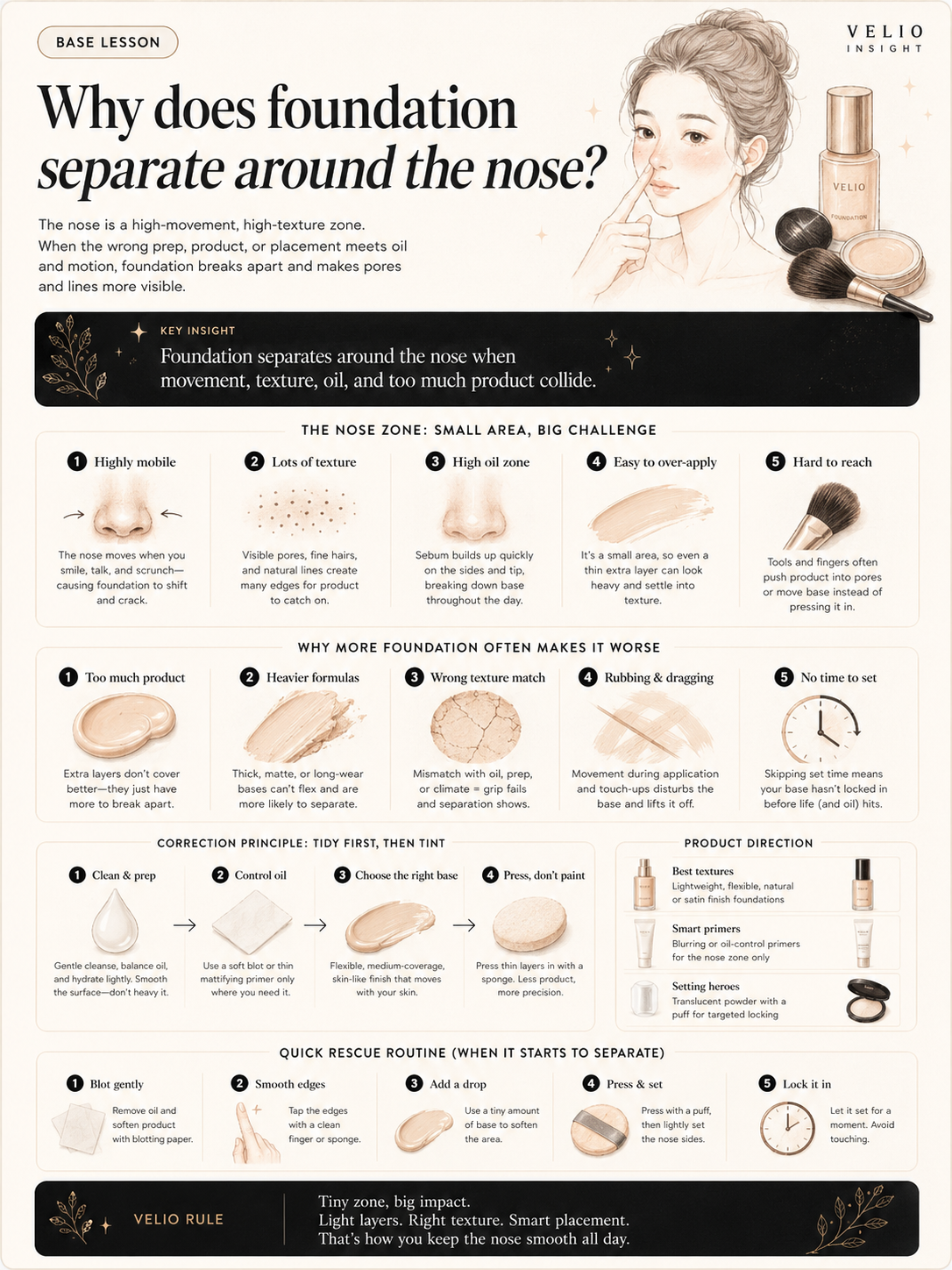
The useful decision is not more foundation everywhere. It is a small correction route: lift, press, and set only where the layer broke.
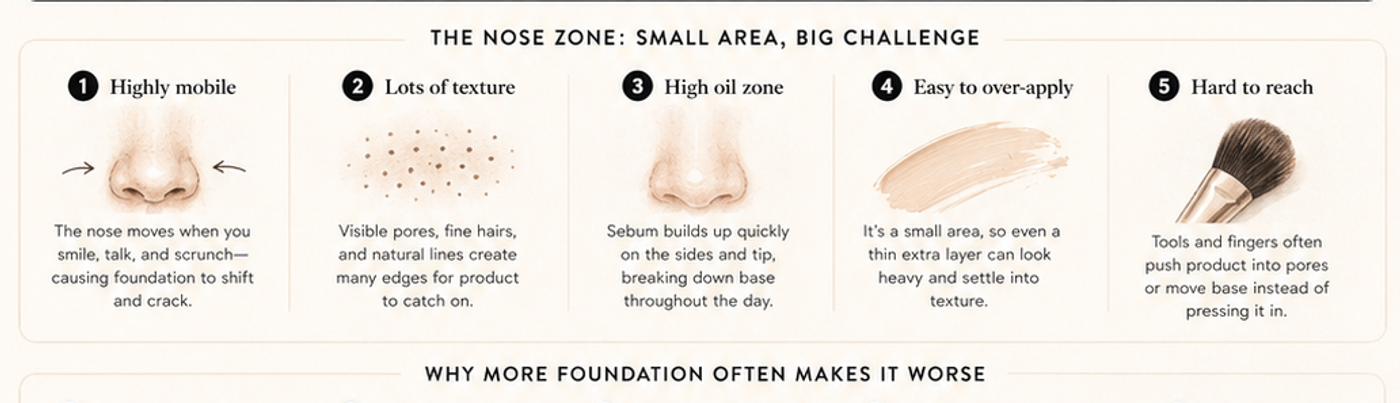
The nose zone behaves differently from the cheek. Read the small area first before rebuilding anything.
The nose area moves, warms, and collects product differently from the cheek. That is why a base can look smooth everywhere else while one tiny seam starts to split.
VELIO treats this as a product-role problem. The question is not which foundation is strongest; it is which product family helps the small zone stay thin, clean, and controlled.
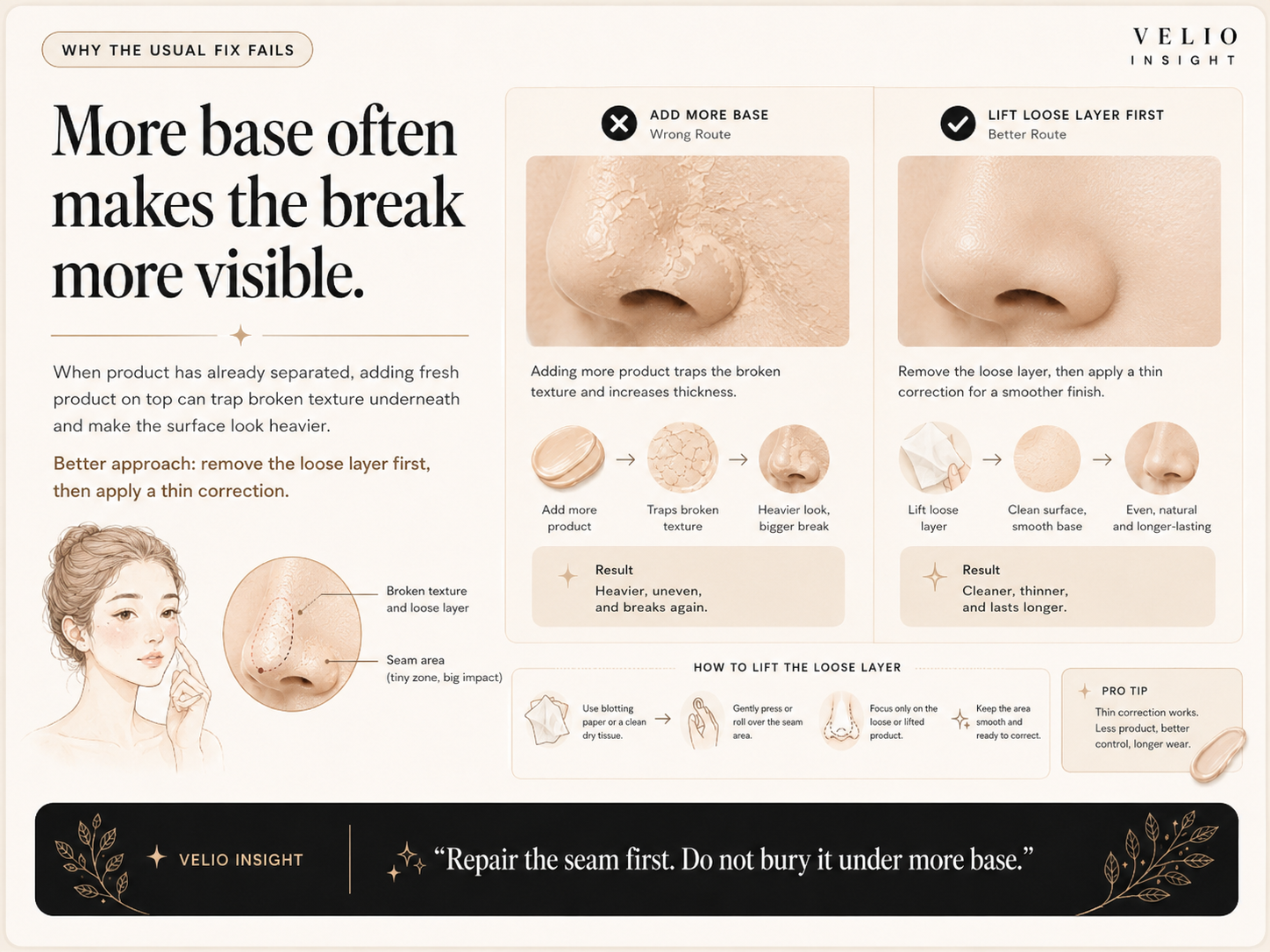
Removing the loose layer first keeps the repair smaller, cleaner, and easier to blend.
When product has already separated, adding fresh product on top can trap the broken texture underneath. The surface may look heavier even if the amount added is small.
A better route is to remove the loose layer first. Then the correction product can sit on a cleaner surface instead of fighting the old layer.

The most useful product direction is tomorrow's lighter prep, thinner base, and smaller correction tool.
Tomorrow, build the cheek and center differently. The cheek can hold more blend. The nose fold often needs the thinnest layer and the smallest correction.
If the area still separates, the product direction is not failure; it is evidence that the zone needs a smaller tool, a cleaner surface, or a lighter base family.
Identify the changed area, choose the smallest correction, and stop as soon as the surface looks clear again.
Repaint the entire nose because one small seam separated.
Use a clean sponge, cotton tip, or small brush to lift only the failed layer.
Use thick concealer as a patch before checking the surface.
Correct redness only after the broken texture is smoothed.
Usually the nostril fold, sidewall, or the small area where base meets movement.
Prep, base, concealer, powder, and movement collide in a very small space.
Pushing fresh foundation into product that has already lifted.
Remove loose product, then press a thin correction only where skin shows through.
Keep nose prep thin and let it settle before base.
Use less product around the fold than on the cheek.
Save concealer for true redness or darkness.
Use a small tool so the fix stays smaller than the problem.
“Repair only the broken seam, then leave the rest of the base alone.”
Youn et al., Skin Research and Technology, 2005
Facial sebum secretion varies by region and season. That supports reading the nose zone separately instead of treating every part of the face as one identical surface.
Jeon et al., Journal of Cosmetic Dermatology, 2022
Foundation wear can be studied through adhesion and stability on skin, which fits VELIO's focus on thin layers, surface prep, and controlled correction.
Professional base-application principle
Makeup artists often correct only where unevenness remains visible, rather than covering the whole face equally.
VELIO product direction framework
Nose separation points to the tool/correction/base relationship, not only to a single product flaw.
The nose area is warm, high-movement, and product-dense. Foundation can separate there when prep, base, concealer, powder, oil, and facial movement collide in a small zone.
Usually not as the first step. Lift the loose or broken layer first, then micro-correct only the visible seam with a thin layer. Adding base directly on top can make the break look thicker.
Keep nose prep thin, let skincare settle, apply less base near the fold, and set only the edge that needs control. A smaller tool helps the fix stay smaller than the problem.
VELIO connects this lesson to soft detail tools, precision concealer, and a lighter center base so the repair stays local instead of becoming a full-face rebuild.
VELIO carries the nose-zone concern into the mirror read and returns one practical color-and-wear route. The goal is a smaller correction, not another full layer.
Free first read · Non-diagnostic · Use what you own first
Start with the lesson and your mirror read. Then browse the small product roles that support the same correction without rebuilding the whole routine.
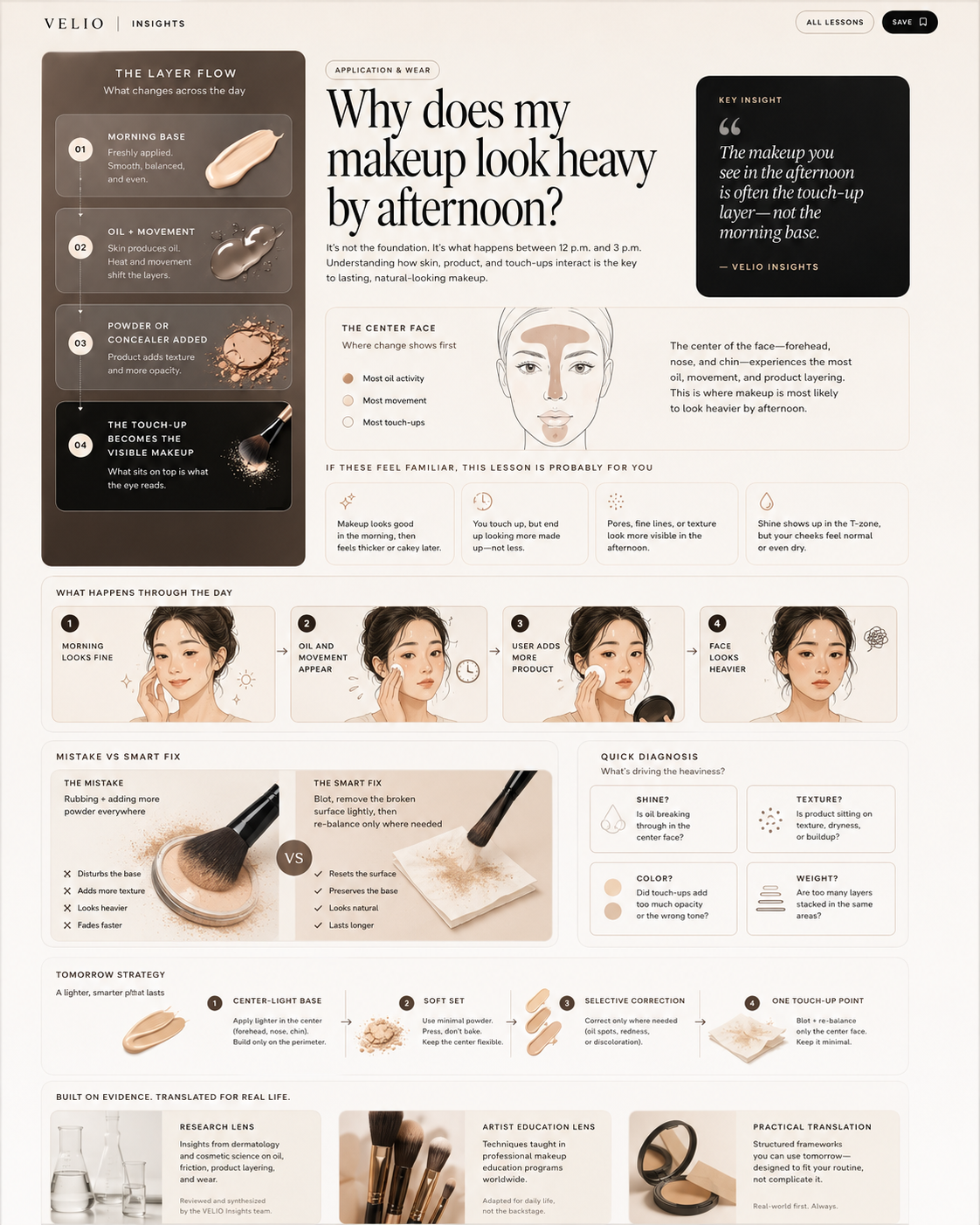
The makeup you see at 3 p.m. is often not the morning base. It is the new top layer created by oil, movement, powder, concealer, and repeated touch-ups.

Humidity does not always mean stronger makeup. Often it means fewer layers, clearer finish control, and one planned touch-up point.

Lift usually comes from direction and placement, not from making the blush stronger or wider.