Why does foundation look patchy on dry skin?
Foundation can look patchy on dry skin because product catches on uneven texture, flakes, micro-lines, and dry zones. More coverage often emphasizes the surface instead of smoothing it.
Patchy foundation on dry skin is usually not about needing more coverage. It is about how product meets uneven surface texture.
“More coverage can create more emphasis on texture.”
VELIO keeps the lesson attached to the mirror experience, then returns one face-aware Color Story and one practical route. It remains non-diagnostic.
Free first read · Non-diagnostic · Use what you own first
Foundation catches on flakes or rough areas even when you apply more carefully.
Coverage looks uneven under natural light or flash.
Powder makes the dry areas look more obvious.
The base looks better at first but separates around dry zones later.
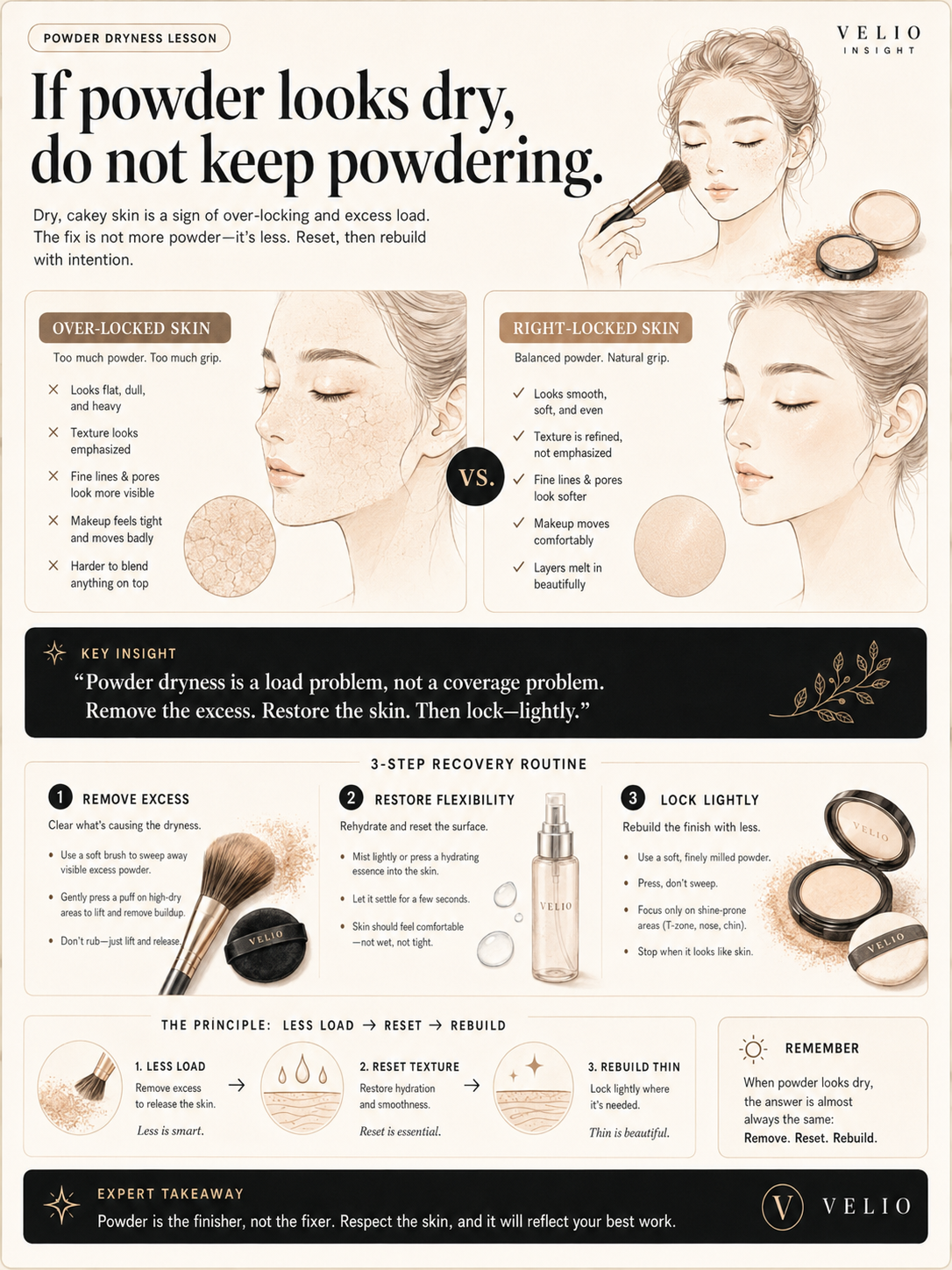
Patchiness becomes more solvable when surface texture, formula flexibility, correction, and setting are treated as different product decisions.
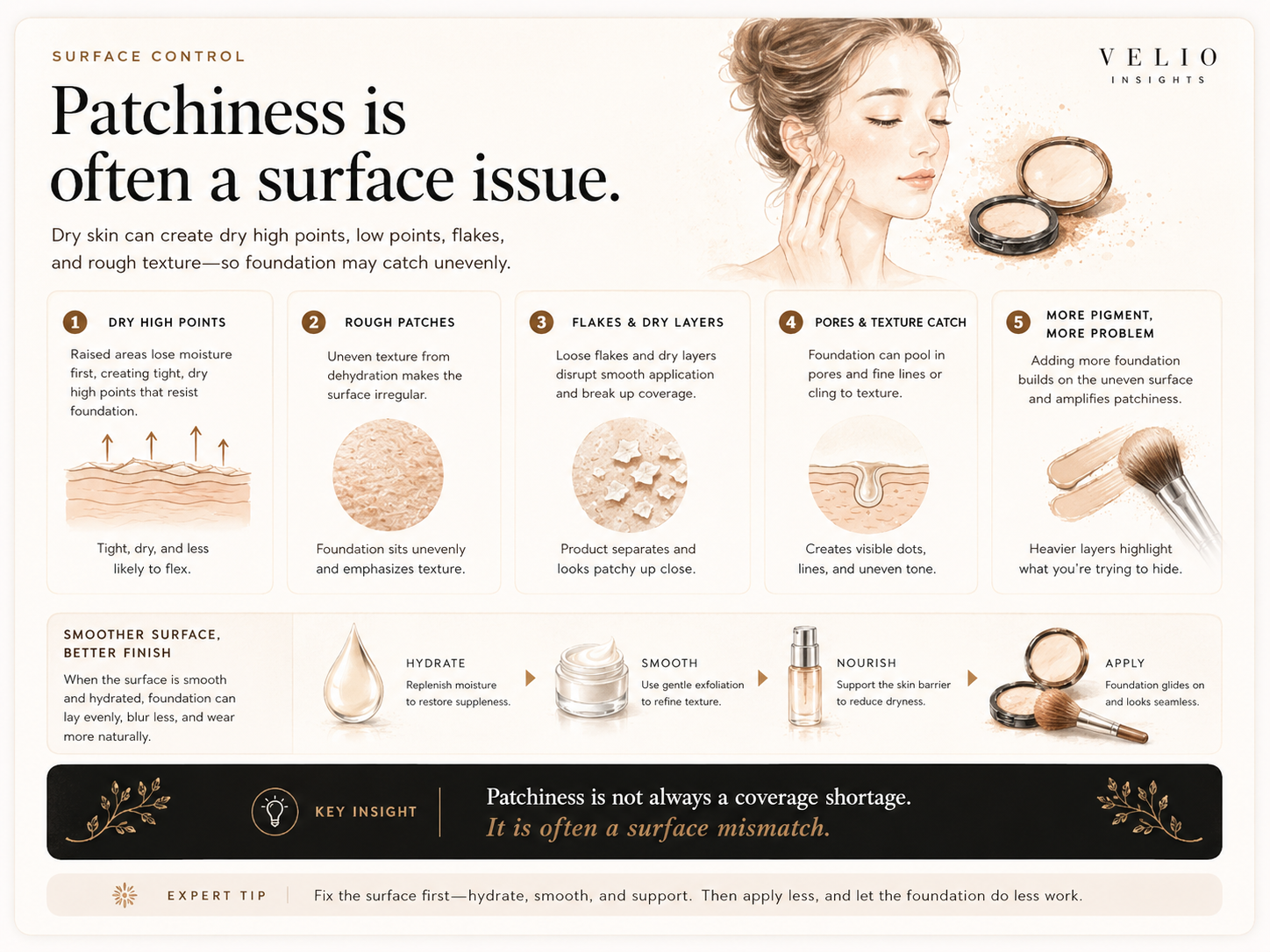
The first lesson is to see patchiness as texture contrast rather than a simple coverage shortage.
Dry skin can create tiny high points, low points, flakes, and rough texture. Foundation does not sit evenly on that landscape. It clings to some areas, skips others, and reflects light unevenly.
That is why patchiness can look worse when more foundation is added. More pigment can make texture contrast louder if the surface underneath has not been supported first.

Dry patches usually need surface support before they need more pigment.
A common instinct is to add more foundation where the base looks uneven. But if dry texture is the cause, thicker layers can collect on flakes and make the patch stand out more under light.
The better fix starts before coverage: hydrate, smooth, and choose a flexible formula. Once the surface is supported, less product can look more even.
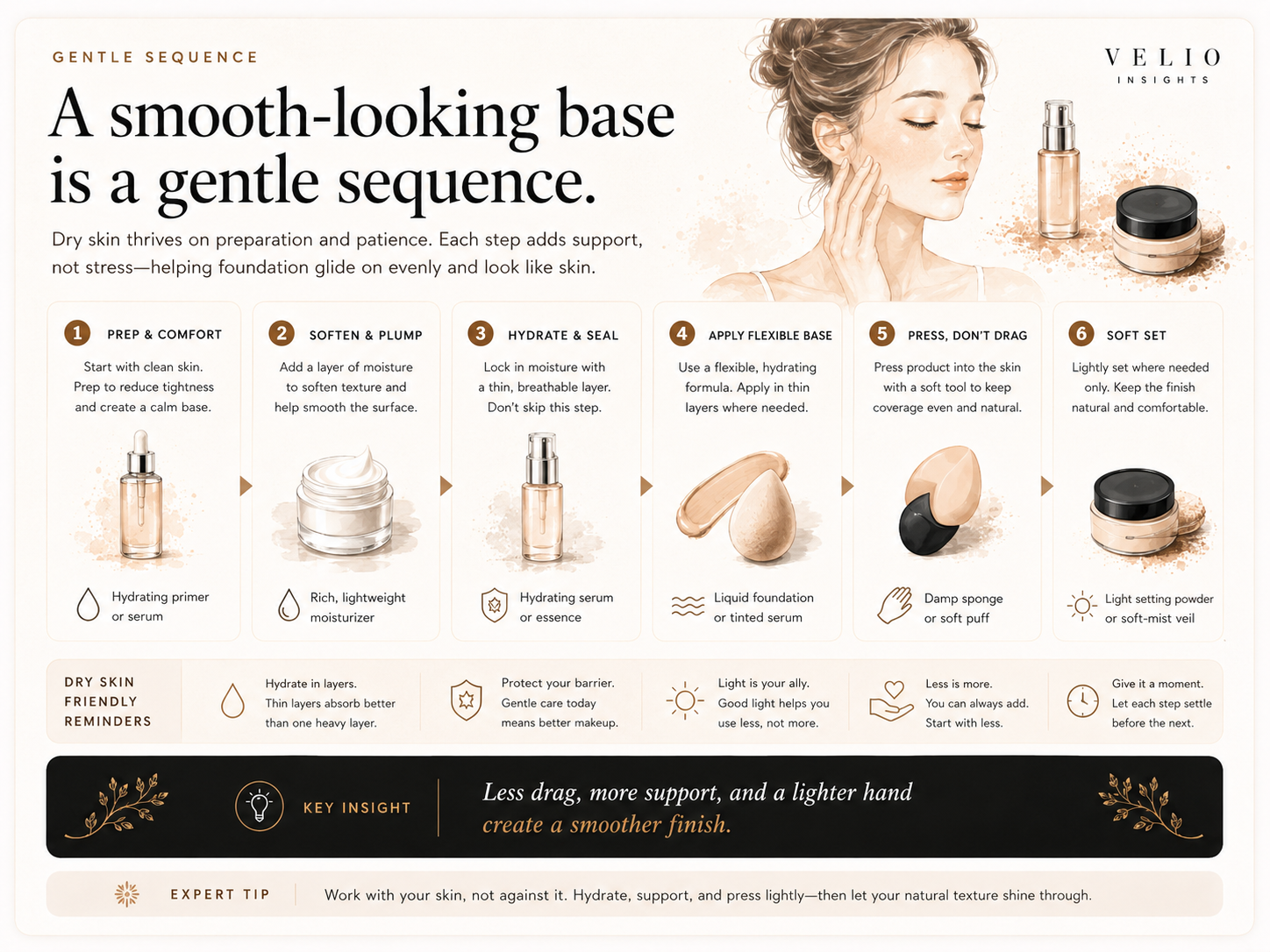
A smooth-looking base is a sequence: hydrate, smooth, apply flexible layers, correct locally, then set with restraint.
Dry-skin makeup works best when the base is built in thin, flexible steps. Hydrate first, avoid dragging, apply a flexible layer, spot-correct only dry breaks, then set softly where shine truly appears.
This also makes touch-up easier. Instead of adding foundation to a patch, you can refresh texture first and then press a small amount only where coverage has broken.
Identify the changed area, choose the smallest correction, and stop as soon as the surface looks clear again.
Adding thicker foundation to hide patchiness.
Smooth and hydrate the surface before adding coverage.
Using powder everywhere to lock the base.
Set only shine-prone areas and leave dry zones flexible.
Dry, raised areas catch product while low areas stay under-covered.
Stiff matte formulas can emphasize dryness instead of moving with it.
Powdering dry zones can make patches look more visible.
Support the surface first, then use thin flexible layers and local correction.
Use light hydration and give it time to settle.
Choose flexible, skin-moving coverage instead of heavy matte layers.
Spot-correct dry breaks with creamier products.
Set softly or skip powder on dry patches.
“Smooth the surface, choose flexible formulas, and set with intention.”
Purnamawati et al., Clinical Medicine and Research, 2017
Moisturizer research supports the idea that hydration and barrier support can change how the skin surface feels before makeup.
Draelos et al., Journal of Drugs in Dermatology, 2021
A topical hyaluronic-acid serum study reported smoothing and hydration-related appearance benefits, supporting VELIO's prep-before-coverage direction.
Professional base-application principle
Many artist routines treat prep, texture control, and selective setting as part of the base itself.
VELIO editorial translation
The reader action is simple: smooth the surface before deciding whether more coverage is needed.
Foundation can look patchy on dry skin because product catches on uneven texture, flakes, micro-lines, and dry zones. More coverage often emphasizes the surface instead of smoothing it.
Usually no. Adding more product can make dry texture more visible. Smooth and hydrate the surface first, then use a flexible base and correct only the areas that need it.
Flexible, skin-moving formulas usually look better than flat matte layers on dry texture. Set softly only where needed, and avoid powdering every dry zone.
VELIO points this problem toward hydrating prep, flexible base, cream correction, and soft-set finish used with restraint rather than blanket coverage.
VELIO keeps the lesson attached to the mirror experience, then returns one face-aware Color Story and one practical route. It remains non-diagnostic.
Free first read · Non-diagnostic · Use what you own first
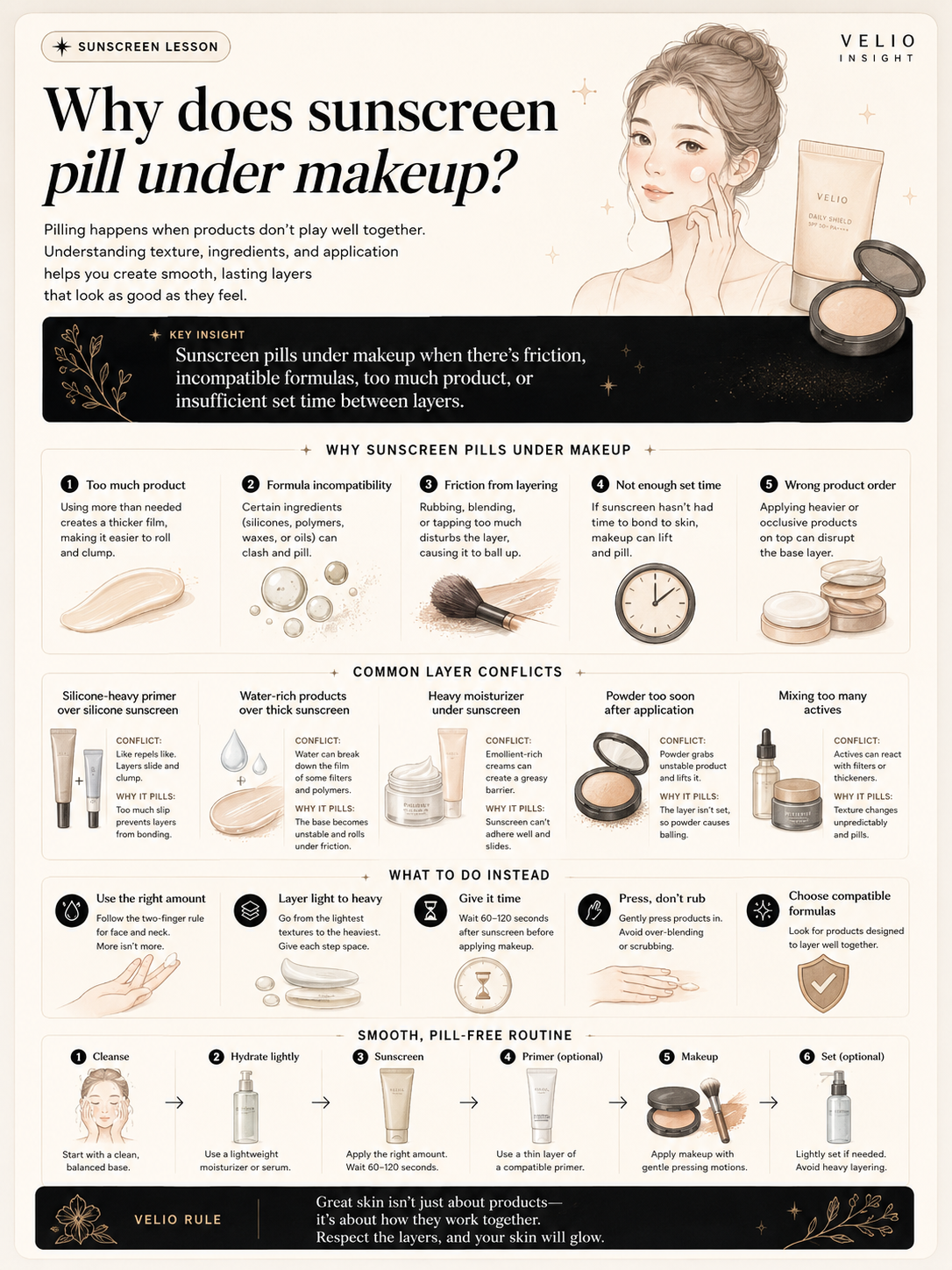
Sunscreen pilling is usually a layer conflict. The fix is better order, less friction, more settling time, and more compatible product families.
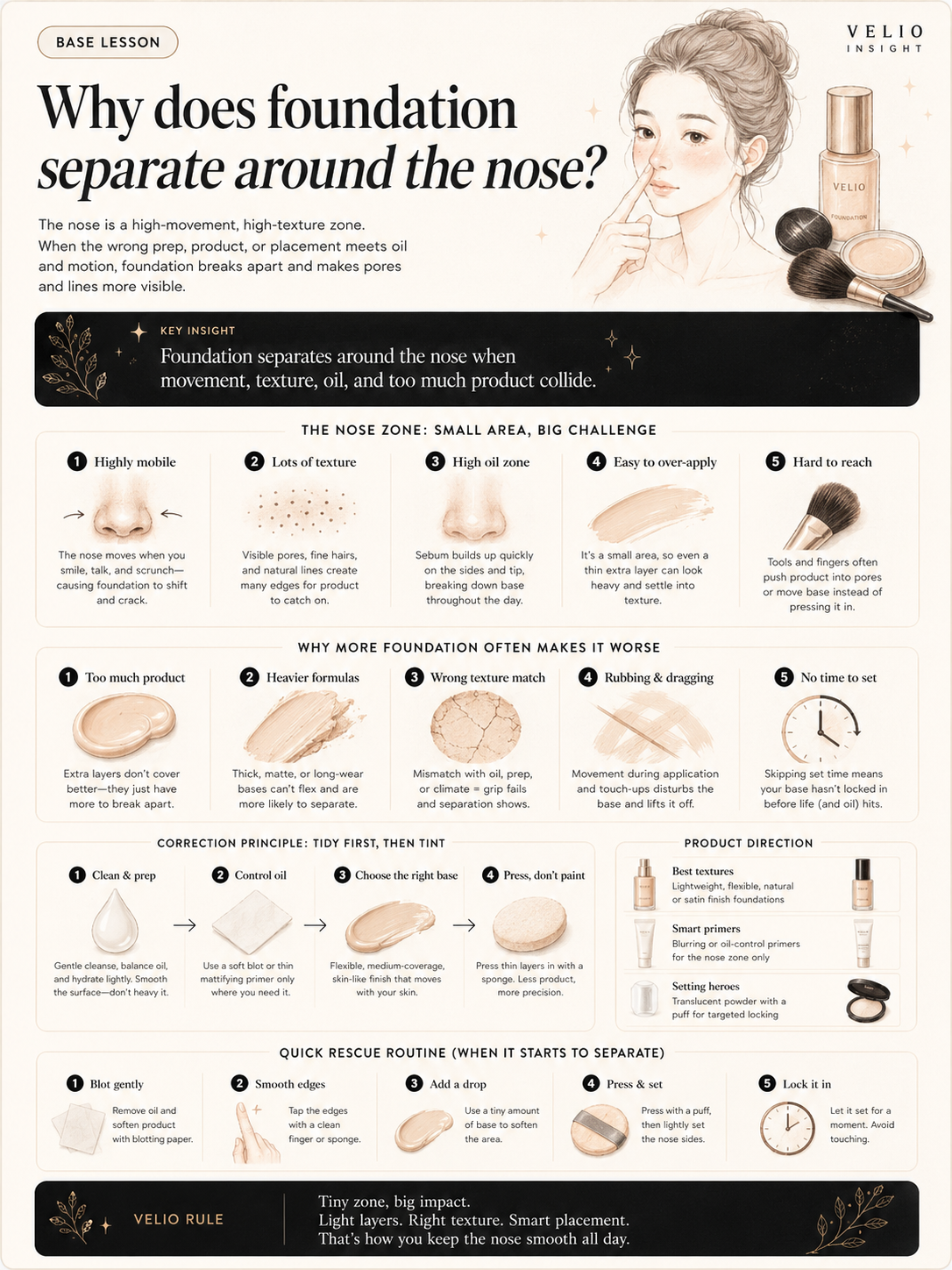
The nose zone is small, warm, and high-movement. Lift the loose layer, flatten the seam, and replace only the coverage that is missing.
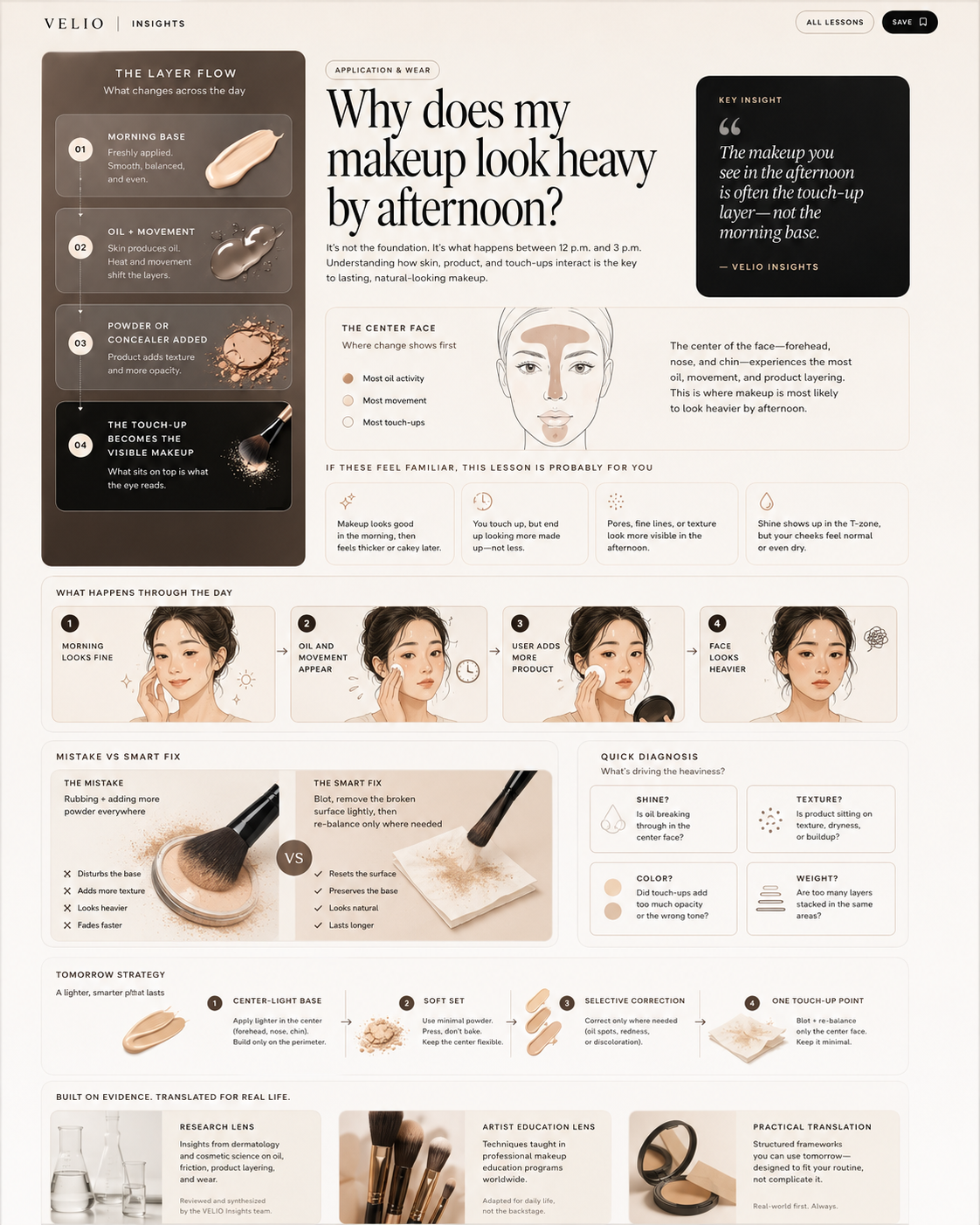
The makeup you see at 3 p.m. is often not the morning base. It is the new top layer created by oil, movement, powder, concealer, and repeated touch-ups.